Mixed Needs Parenting
What Does PEACE in Our Family Culture Really Mean? Understanding the Framework Behind Calmer Homes
February 5, 2026
If you’ve been following along with the PEACE challenges, you might be wondering what that acronym actually stands for. It’s more than just a cute name—it’s a complete framework for moving your family from reactive chaos to intentional calm.
Let me break down each letter and show you how they work together.
P – Presence
This is where it all starts. Presence means stopping long enough to notice what’s actually happening. Not just the behavior you’re seeing, but what’s beneath it.
What’s triggering you right now? What’s triggering your child? Where are you emotionally, physically, mentally?
Before you can respond well to anything, you have to be present to it. This isn’t about achieving some zen state of mindfulness—it’s simply about paying attention. When we’re present, we can see what’s really going on instead of just reacting to the surface chaos. Plus, our minds stop racing with worry about the future or dread about the past. We focus on where we are in the present. Remember, as C. S. Lewis pointed out, it is in the present when we touch eternity. God presence is in our present.
E – Emotions
Once we’re present to what’s happening, we need to regulate our emotions. Notice I didn’t say “suppress” or “ignore”—I said regulate.
This is about self-control and stopping the escalation before it spirals. It’s recognizing “I’m getting angry” or “My child is getting overwhelmed” and choosing not to let those emotions drive the bus.
Emotions are real and valid. But they don’t get to make our decisions for us. When we learn to regulate—and teach our children to do the same—we create space for actual connection and problem-solving instead of just emotional reactivity.
We live in a world where emotions rule and reign. That is not what we want if we want a Christ-centered, peace-filled home. We master our emtions–not the other way around.
A – Assessment
Here’s where we ask the harder questions. Assessment means figuring out what actually set this off, what’s really troubling us, what’s happening beneath the behavior.
Your child isn’t throwing a fit because they’re “bad” or “trying to manipulate you.” There’s something deeper going on. Maybe they’re hungry, overstimulated, feeling unheard, or genuinely struggling with something they can’t articulate yet.
And honestly? The same is true for us as parents. When we lose it with our kids, it’s rarely just about the spilled juice or the messy room. There’s something deeper—our own stress, our unmet needs, our triggers from our own childhood. Or it might even be just a snarky tone and unkind word the barista had when we bought our coffee. Whatever it is, big or small, we need to figure it out and assess the situation. Once we know what happened, we can react with wisdom and grace–and the help of the Holy Spirit.
Assessment helps us get curious instead of furious.
C – Calm
This is the goal: returning to calm from chaos. And not just once, but building the skill so we can do it more quickly each time.
Calm isn’t about never having hard moments. It’s about developing the capacity to come back to center when things get hard. It’s teaching our bodies and our children’s bodies that we can handle stress without falling apart.
Some days you’ll get back to calm in five minutes. Some days it takes an hour. That’s okay. Progress, not perfection. The point is you’re building the skill, and over time, you’re getting faster and more resilient. Calm is becoming our normal rather than chaos. It’s a central part of our family culture because we’re creating it and teaching our children how to embrace it.
E – Emmanuel
Here’s what makes this framework different from every other behavior management system out there: Emmanuel—God is with us.
Everything is spiritual. There’s no sacred-secular divide in family life. Your toddler’s tantrum, your teenager’s attitude, your own overwhelm—all of it matters to God, and all of it is an opportunity for discipleship.
When we remember that God is with us in these hard moments, it changes everything. We can pray anywhere, anytime. We can access His wisdom, His strength, His patience when ours runs out. And we can teach our children to do the same.
This isn’t about trying to earn God’s favor through perfect parenting. It’s about recognizing that He’s already present in the mess, and we can learn to lean into Him right in the middle of it. His presence, wisdom, peace, and joy are there in every situation. He NEVER leaves us or our kids.
How It All Works Together
The PEACE framework isn’t a checklist you work through every time your kid acts up. It’s a way of approaching family life that builds a foundation of calm over time.
When you practice Presence, you become more aware. When you work on Emotions, you build self-regulation. When you get good at Assessment, you become curious instead of critical. When you prioritize Calm, you create safety. And when you remember Emmanuel, you ground it all in the reality that God is with you in this.
That’s what the PEACE challenges are all about—giving you practical tools to build each of these skills, one week at a time. Not because you’re broken and need fixing, but because you’re a parent who wants to grow, and your family deserves your best.
And here’s the beautiful part: when you build PEACE into your family, you’re not just reducing blowups and creating calmer homes. You’re doing real discipleship work—with your kids and with yourself.
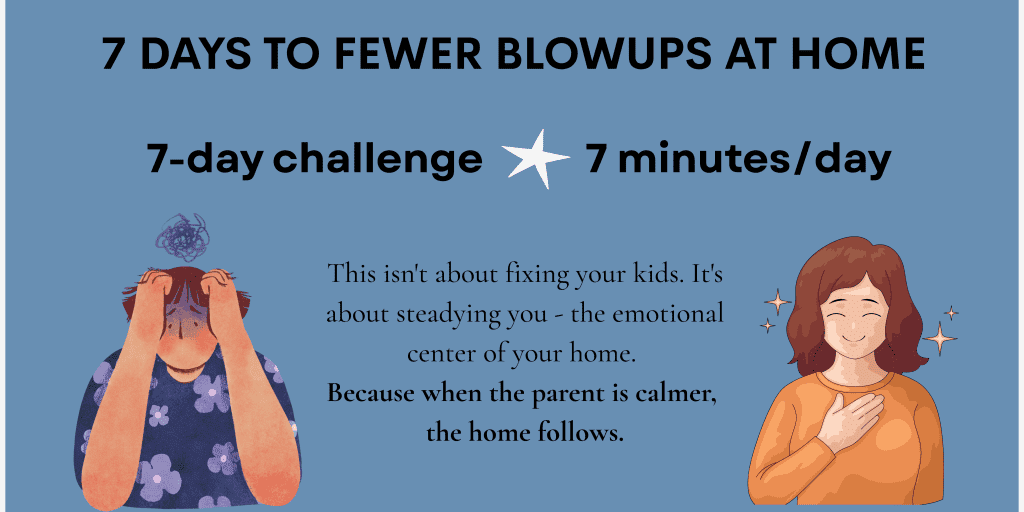
Ready to put PEACE into practice? The PEACE challenges give you short, actionable 7-day experiences (for 7 minutes a day) to build these skills into your family. Start wherever you are, and let’s move forward together.