
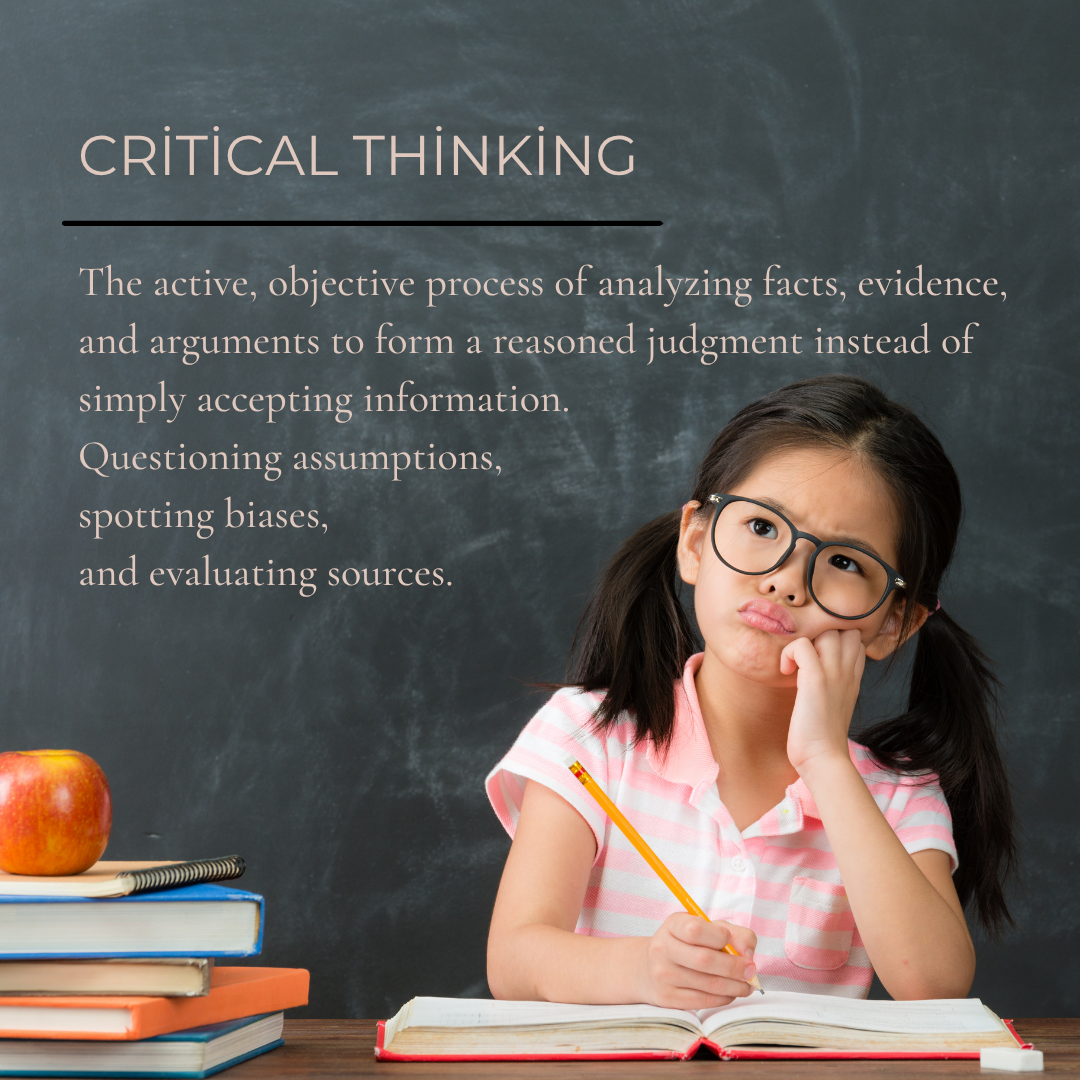
When we hear “critical thinking,” most of us picture a certain kind of child: verbal, quick, ready to debate the family into the ground. If that’s not the child at your table, it’s easy to conclude that this month’s theme is for somebody else’s family.
It isn’t. But we need to take apart an assumption first: that thinking sounds like talking.
Some children reason beautifully and can’t narrate a word of it. Some think in pictures (see Thinking in Pictures by Temple Grandin), or in steps, or with their hands. Some are concrete thinkers for whom “what do you think would happen if…” is a genuinely confusing question. Some are still working on naming what they feel, let alone defending what they believe. If your family includes more than one kind of brain — and in a mixed-needs home, it does — then critical thinking will not look the same from one child to the next.
At its core, thinking is not debate. It is weighing and choosing. Noticing there is more than one option. Considering what might happen. Picking, and then seeing what the choice taught you. Every child God made can grow in that — at their own pace, through their own doorway. “God arranged the members in the body, each one of them, as he chose” (1 Corinthians 12:18). He did not arrange one kind of mind and call the rest mistakes. The child who reasons without words is not failing at thinking. She is thinking in her own language, and our job is to learn to hear it.
So what does that look like? Shrink the choice: not “what do you want to do,” but two real options, both visible, both acceptable to you. Then — and this is the part I had to learn — narrate the reasoning back: “You picked the red cup because the blue one was dirty. That was problem-solving.” A child who cannot yet describe her own thinking can still hear it described, and something in her sits up straighter: I did that. And slow everything down. One question at a time. A pause that feels too long. Processing is not the absence of thought; it is thought, working.
The mistake to avoid is the shortcut in the other direction — deciding a child “can’t” and quietly removing every choice from their day. A child with no choices gets no practice, and a child with no practice will always look like a child who can’t. Start smaller than feels useful. Smaller than that, even. Then build.
I have a lot more to say here than one post can hold, so this month I recorded two full podcast episodes on teaching critical thinking to a neurodivergent child — what it looks like at different ages, and how to tell the difference between a child who won’t reason and a child who reasons differently. They’re linked below, and I hope they meet you right where your family is.
Listen to both episodes here: They're Already Critical Thinkers and 3 Tips for Improving Critical Thinking