Books & Resources
Teaching Kids to Pray: Beyond “Now I Lay Me Down to Sleep”
October 31, 2025
“Now I lay me down to sleep, I pray the Lord my soul to keep…”
I don’t know if anyone still prays this prayer at bedtime, but it always kind of creeped me out that maybe I was going to die that night. But that’s not the point of this post or that prayer.
I remember prayers at mealtime were either “God is great. God is good. Let us thank him for our food.” or if my dad prayed, I wasn’t quite sure what all he said, because he kind of mumbled, but it was always the same. That was how we learned about prayer when I was a kid. Oh, I’m sure my pastor taught about it. He was a great Bible teacher, but I only remember what I experienced and the examples I heard.
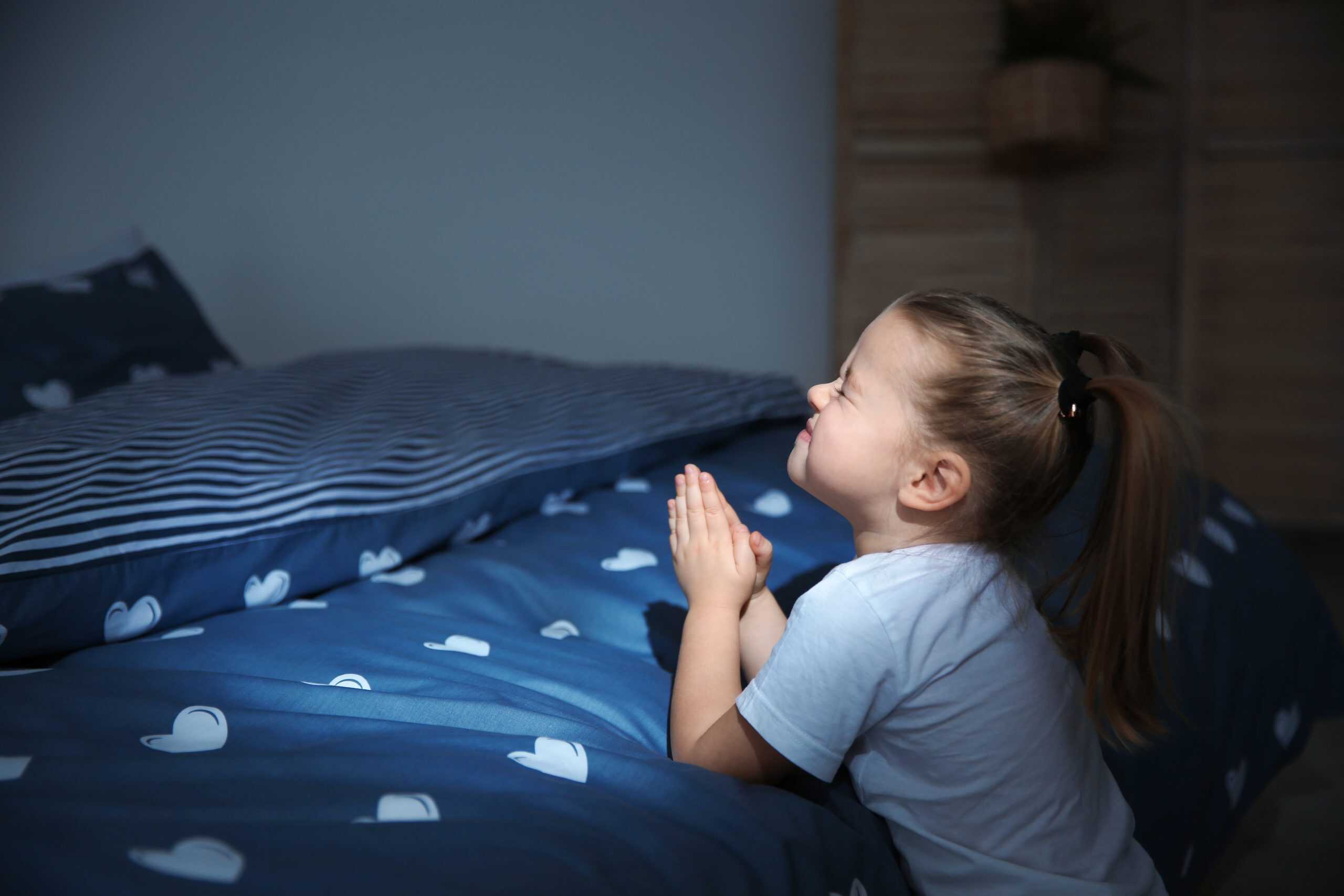
It’s the same for most children. So, we need to consider what our children are learning in our family culture about prayer? Do we hear from our children, “Do I have to pray?” Or do they rush through the rote prayer we’ve taught them? Or do they sit silently, hands folded, eyes squinched closed, and head bowed, with their head and heart engaged, maybe?
We all want our children to have a real relationship with God, not just memorized words and mimicking behavior. I promise you, prayer doesn’t have to be complicated or formal. It doesn’t have to contain “thee” and “thou” or “yea verily” – Yea verily. [yes, truly]
Prayer can be natural, conversational, and actually something children want to and love to do. Let’s talk about the Why, What, and the How, and help our children love praying.
WHY KIDS NEED TO LEARN PRAYER (The Why Before the How)
This may seem silly because, if you’re like me, you’re thinking, of course I know why children need to learn to pray. They need to talk to God. They need to build their relationship with him and learn to trust him with their wants and needs. However, after teaching children (my own and other peoples’) for years, I find when I’m teaching about prayer, I teach the how and never the why. I focus on folding the hands (basically so they won’t be touching other kids or fidgeting with something while we’re praying), closing their eyes (so they aren’t distracted and are supposedly focusing on the prayer), and bowing their heads (this is where I got it right because we would talk about reverence for God and showing him respect by bowing our heads).
So what are our real reasons for praying?
What prayer actually is for kids
- More than just asking for things – we know even in our own praying we can fall into the trap of simply asking constantly for what we need and want. That’s fine. We should ask God for everything, but when that is our focus in prayer, when that is all we teach our children that prayer is, we are missing so much. We might as well be sitting on Santa’s lap asking for all the things we want. We don’t want our children to ever hesitate to bring a concern to God, but if prayer is to become a relationship nurturing part of their walk with God, we must help them see that it is so much more.
- Reality, not performance or recitation – We often teach prayers that our children can memorize and repeat, and it is a beautiful part of many denominations as well as Scripture. However, we must help our children and ourselves never lose sight of the meaning and beauty of these prayers. This is why it is important to teach them more than just repetitive prayers. We must share our hearts in prayer and help our children share theirs as well. We don’t want the words of memorized prayer to become meaningless babbling, kind of like Jesus warned in Matthew 6:7 where people prayed lots of words just to sound good. The words we pray, whether memorized or poured out from our own hearts and minds, carry importance. They must always be real because we are talking to a real God.
- It’s a conversation with someone who loves them – This is the key we need to grasp and share with our children. We often tell children they are talking with God, but do we recognize how wonderful it is to be in God’s presence, sharing our hearts with him, and knowing that he completely accepts and loves us. I’m not even sure I can communicate very well what is on my heart here, but I want to try. When we come to God in prayer, we have his ear and his heart. We are in the presence of our Father who loves us. That means, not only does he listen and answer, but we will never get “stink eye” from him, a sarcastic response, or a sigh or eye roll because we’re bothering him again. No, we will always get a welcome and the equivalent of an outreached arm. And it’s not because we are so wonderful, but it is because he is. The other part of it is that while we pray, he may rebuke us or reveal truth to us, but he does it in such a way that we feel blessed and wiser rather than shamed or disgraced. We rarely accomplish that as human beings or as parents. He is the perfect parent who hears and answers.
- It’s learning to talk to God the way they talk to people they trust – Trust is so important in our lives and especially in our children’s lives. God is more trustworthy and loving than anyone else our children will ever know. We want to help them understand that they can talk to God about anything, any time, and anywhere, and he always hears. He always answers. He always does what is best for us. I love the verse (Hebrews 4:16) that says we can enter his throne room boldly, not because we’re so awesome but because of his great love and mercy. That openness in his invitation to us shows that we can talk to him about anything and trust him completely.
A few things prayer teaches kids about God
- He listens
- He cares about the small stuff, not just the big stuff
- He loves them even when they’re confused or angry or questioning
- He’s present and real, not distant or a fairy tale
Why it matters
- Prayer is how kids learn to hear God’s voice – I know, this freaks some people out. I’m not talking about literally hearing a voice. I’m not talking about adding to Scripture. I am talking about listening to or paying attention to the leadership of the Holy Spirit. He is real and active and always at work in and around us. He guides and comforts us. As we read the Bible and learn it, we also “hear” God’s voice because the Bible literally is the Word of God. Impressions, promptings, ideas, or whatever you want to call it when the Holy Spirit “speaks” to us, will always be in line with Scripture. The Holy Spirit will never contradict the Bible, ever. However, when we pray, and when our children pray, God will speak to our hearts and minds. And we need to hear and obey. Many of us are so afraid of our kids thinking they’ve heard something from God that is not true or way out in left field. If our children are truly followers of Christ and have the Holy Spirit, we must teach them to pray and listen to God’s leading in their lives. God is alive and real. He loves and hears. And he leads. If our children start feeling led to do things that are wild and not biblical, we simply look in the Bible together. In fact, we’ve done it when they are on target and the Lord is leading them in a certain way. We show them the Scriptures that show this is how God speaks and works in our lives. So, don’t be afraid. Help them walk in wisdom and knowledge of God and his Word. And then teach them to obey.
- It’s where they practice faith in real situations – As parents we don’t see much in life more beautiful than our children trusting God and following him. When we see our children pray trusting God and believing he hears and cares, we are watching their faith grow.
- It builds confidence that God is present in their everyday lives – Prayer helps our children acknowledge God’s presence with them through every situation in their days. As they grow in their faith, they also develop a true confidence and trust in God and know he will always be with them and never leave them. They will never walk anywhere alone in this world.
- It’s the foundation for a lifelong relationship with God – Building healthy prayer habits while our children are young helps them develop lifelong spiritual habits, and their faith grows beautifully as they know God more.
SIGNS THAT PRAYER IS TAKING ROOT
- Children initiate prayer on their own
- They pray about things that matter to them, not just what we’ve taught them
- We overhear them praying when they think no one is listening
- They come to us and say “I prayed about that and I feel better”
- They ask God for help in a tough moment
- They notice answered prayers and mention it
- Prayer becomes as natural as talking
ONE THING TO TRY THIS WEEK
Simple starting point: Choose one moment this week—maybe dinner or bedtime—and pray out loud about something real. Let your kids hear you talking to God naturally. You don’t have to teach anything or make a big deal of it. Just pray.
Then invite them: “Want to tell God something?” Don’t push if they’re not ready. Just let them see that you pray because God is real and listening.
SOME THINGS TO THINK ABOUT
What place does prayer hold in our family culture? Does it have the priority it should? Do we treat it as real or as a habit? We need to ask God to help us evaluate what our children are experiencing in prayer in our home and what examples of prayer they are seeing modeled for them because that’s how they learn what prayer is all about. Prayer is one of the greatest gifts we can give our children—not because they’ll become perfect or never struggle, but because they’ll know they’re never alone. They’ll have a direct line to God, a way to process their big feelings, and a foundation for faith that carries them through everything.
Start where you are. Use your own words. Be imperfect and real. That’s the prayer your kids need to learn.
Let us then with confidence draw near to the throne of grace, that we may receive mercy and find grace to help in time of need. (Hebrews 4:16, ESV)
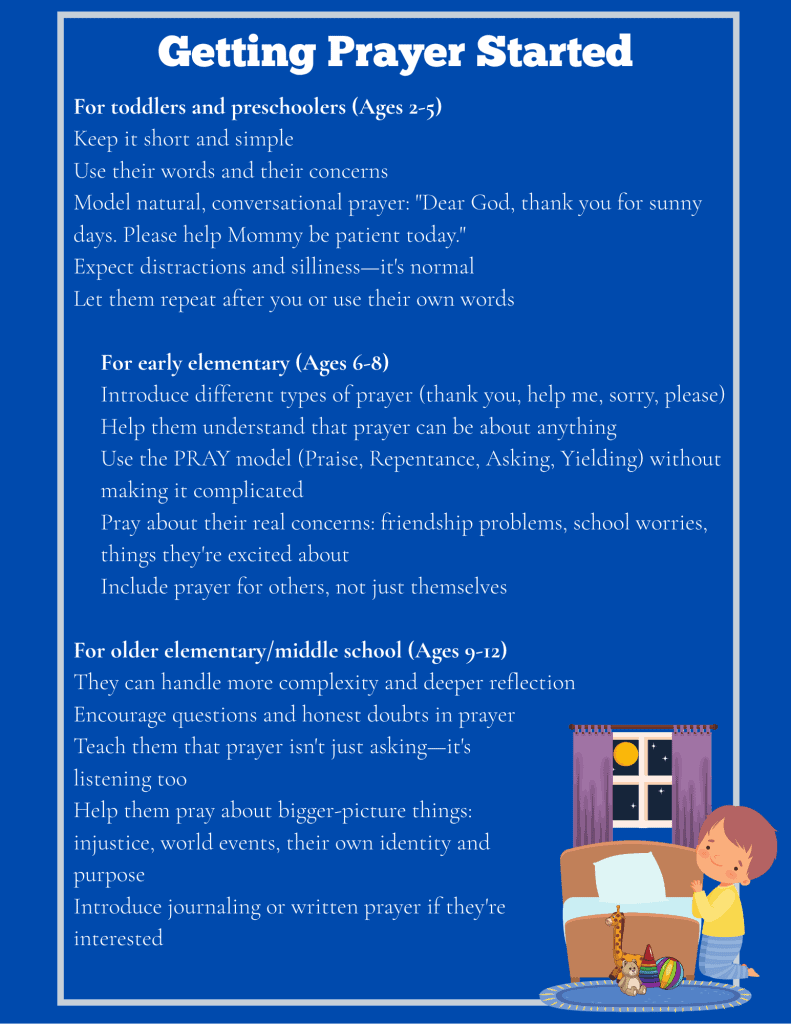
Free Download: Getting Prayer Started
Free Download: Ways to Pray