Books & Resources
Scripture Memory that Sticks, Part 2: Matching the Plan with Our People
August 1, 2025

Last week we talked about the importance of Scripture memory and how to approach it in our families. Now that we’ve established why Scripture memory matters for our families, let’s tackle the practical question every parent asks: ‘But HOW do we actually do this with real kids? What does this actually look like with a squirmy 3-year-old? A resistant 12-year-old? And what do you do when your best-laid plans fall apart? Let’s do a deep dive into some strategies and problem-solving to hopefully make your Scripture memory come alive in your family.
Simple Plan for Memorizing and Understanding Verses
Sometimes we can make memorization seem harder than it is. Don’t get me wrong. I struggle with memorizing, but our pastor shared what works well for him, and he’s right. Basically, spending around four minutes a day on memorization can help us be successful. If, at first, four minutes is too long for your little ones, try two minutes. The main thing is to keep planting those Scripture seeds in your hearts.
You may want to try a plan like this:
Sunday or Monday: Introduce this week’s verse or verses and begin learning the words. Usually this can be accomplished by spending about four minutes each day going over the verses.
Tuesday: Understand the meaning and review the verses, again, for about four minutes.
Wednesday: Review verses with a game or activity taking four to thirty minutes.
Thursday: Go a little deeper and find ways to live out the verses. Brainstorm as a family, and, of course, review the verses together. The review should take about four minutes, and the brainstorm can take about 10-15 minutes. End with a prayer of commitment and asking for God’s help as you seek to obey his Word.
Friday: Say the verses from memory and create a visual (sticky note, poster, etc.) to put up somewhere in the house for reviewing and reminding everyone of the verses you’ve learned.
Saturday or Sunday: Share how God used the verses in your life.
If you follow the Bible memory program we have through Everyday Discipleship Everyday, we memorize 1-3 verse per week. They are posted on Facebook and Instagram each week as well as in our Facebook group. During the summer, we have a summer Bible memory challenge with free downloads and a certificate of completion. Families can also request free stickers.
However, you may want your family to memorize a passage each month instead of weekly. You can choose the first week’s verses from our program or choose your own verses. Prayerfully consider what will work best for your family. The main point is that we are all hiding God’s Word in our hearts and in the hearts of our children.
Age-Specific Strategies for Making Bible Memory Stick
As parents and teachers, we must remember developmental levels so that we can teach our children well, not frustrate or bore them with whatever we are teaching them by making our lessons too difficult or too easy. This is relevant in memorizing Scripture as well. Here are some considerations and ideas for each age level:
Toddlers (2-4):
- Bible “thoughts” vs. full verses – We break down the basic ideas in verses into simple thoughts with our littlest ones. For instance, instead of having them try to memorize John 3:16, we teach them “God loves the world” or “We believe in Jesus,” and we can use it in conversation, story time, and when we’re working on Bible memory. Use simple, repetitive words and phrases. We recognize that toddlers may not repeat verses or Bible thoughts back to us yet. That is one reason we use the ideas in conversation. Those seeds are being planted. They will begin repeating and reciting when they are ready.
- Using picture books – We have many picture books and board books that are based on Scripture. We can enjoy reading these with our littles and see them enjoy the pictures and time together reading while the Word of God is being planted into their little hearts.
- Sing simple songs – Songs are also powerful for memorizing anything with children, especially 2-4 year olds. Use actions and hand motions or even sign language as you sing. This will involve the child’s whole body and help make the words come to life and make more sense and connection with the child.
- Making it playful, not pressured – Above all, keep Bible memory fun, playful, and stress-free. This is nothing to get stressed about. This is a time for family unity and meaningful memories. Keep the focus on the importance of relationship with each other, with God, and with his Word rather than focusing on a chart of accomplishment.
Elementary (5-10):
- Moving from thoughts to complete verses – With 5-7 year olds we want to use shorter complete verses like Proverbs 3:5-6 or 17:17. Years 8-10 can begin memorizing a little longer verses, but still, they should be easy to understand and not too long.
- Using rewards appropriately (without making it performance-focused) – Much of this has to do with our attitude. Do we hold a sticker in front of them like a carrot they could miss out on, or do we celebrate what they’ve learned by putting a sticker on a chart? Are we focused on the sticker being the end or understanding and applying the verse in our lives? Having rewards can make memorization more fun and can be a visual way children can see that they are accomplishing their goals. We’ll notice when the attitudes are not quite right when children fuss over who has won the reward and their lives reflect competition rather than celebration for each person’s success. Celebrate improvement/progress, not focus on perfection such as “Wow, you remembered three more words today!”
- Sibling dynamics in family memory time – Children usually enjoy teaching their younger siblings. You can bless your children by encouraging activities where they can help one another or read to each other rather than competing with one another. Often these times include laughter and silliness. Enjoy it. I remember when my oldest tried to teach her little brother. She taught him the alphabet, but she also taught him to put his empty bowl on his head after he ate, which was one of her favorite things to do as a toddler, often right after she’d had her bath! LOL! But we have the cutest pictures from those times and the fondest memories.
- Group recitation: Reciting verses together as a family is beneficial at this age. It is fun, rhythmic, and community-building for children. In addition to memorizing verses this way, we can also use verses we’ve already memorized to comfort our family in times of need such as reciting Isaiah 41:10 together during a medical crisis or a storm. Then, lead into prayer together as a family.
Tweens/Teens (11+):
- Words of affirmation – No matter what our child’s love language is, I’ve never met a tween or teen who does not doubt themselves and who doesn’t appreciate words of encouragement or affirmation. Depending on our children’s attitudes at this age, we can expect bigger things from them. Most enjoy a challenge and rising to it. They usually like that we think they can do more than they think they can. My parents always told me I could do anything I put my mind to when I was a preteen and teen. It spurred me on to make good grades and to come out of my shy shell and begin writing and creating art. I found out I loved journalism. Encourage them and let them know you believe in them. It will go far in helping them stick with it.
- Longer passages – With Bible memory, our tweens and teens my want to tackle a full chapter or book of the Bible. We can give them opportunities to stretch themselves without requiring or forcing it. If they are a bit rebellious at this stage, giving them more freedom and ownership can work well. Acknowledge that they are growing up and growing in their faith, not just relying on yours. However, we must draw the line at disrespect. We need to show respect for them and expect respect from them. Remind them that they are part of the family, and the family is memorizing Scripture. Then, we can give them some choices after that.
- Deeper Context – Maybe they would rather dig into the context and meaning of the verses rather than memorize more verses. They may want to keep a journal and write down what they learned about the culture and context of the verses they are memorizing. This stretches their brains and biblical understanding, and if they are enthusiastic about it, they will keep going on their own.
- Having them teach younger siblings – We have another opportunity to have the older siblings teach the younger. Depending on how many children we have, we can pair them up with Bible memory buddies. We can encourage them to use the songs and activities we’ve learned to teach and comfort younger ones such as singing “Jesus Loves Me” to comfort scared sibling.
- Connecting verses to their real struggles (peer pressure, identity, etc.) – At this age they want to know why they must do anything they don’t really want to do like learn algebra and history or clean their rooms when they like them the way they are. They need those kinds of answers when learning Scripture too. Connect verses to real life. Encourage them to notice when God uses verses in their lives. Share your own testimonies of when the Holy Spirit brought a verse back to your memory at an important moment. Help them see the value of what they are doing and how alive the Word of God is. Ask them to consider: “How does this verse speak to your current situation?” See what they come up with on their own. For example, a teenager may use Psalm 139:14 to combat negative body image.
Next week, we’re diving into the real talk – what do you do when your 8-year-old rolls their eyes at Bible memory time, or your teenager flat-out refuses to participate? Part 3 will tackle the resistance, the objections, and those moments when your best intentions meet your children’s very human reactions. We’ll share strategies that actually work without turning your kitchen table into a battlefield.
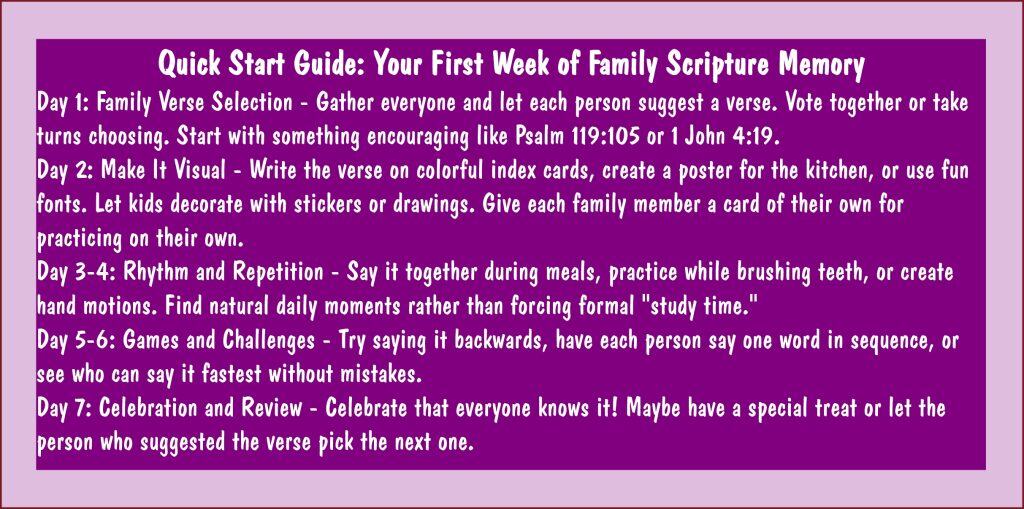
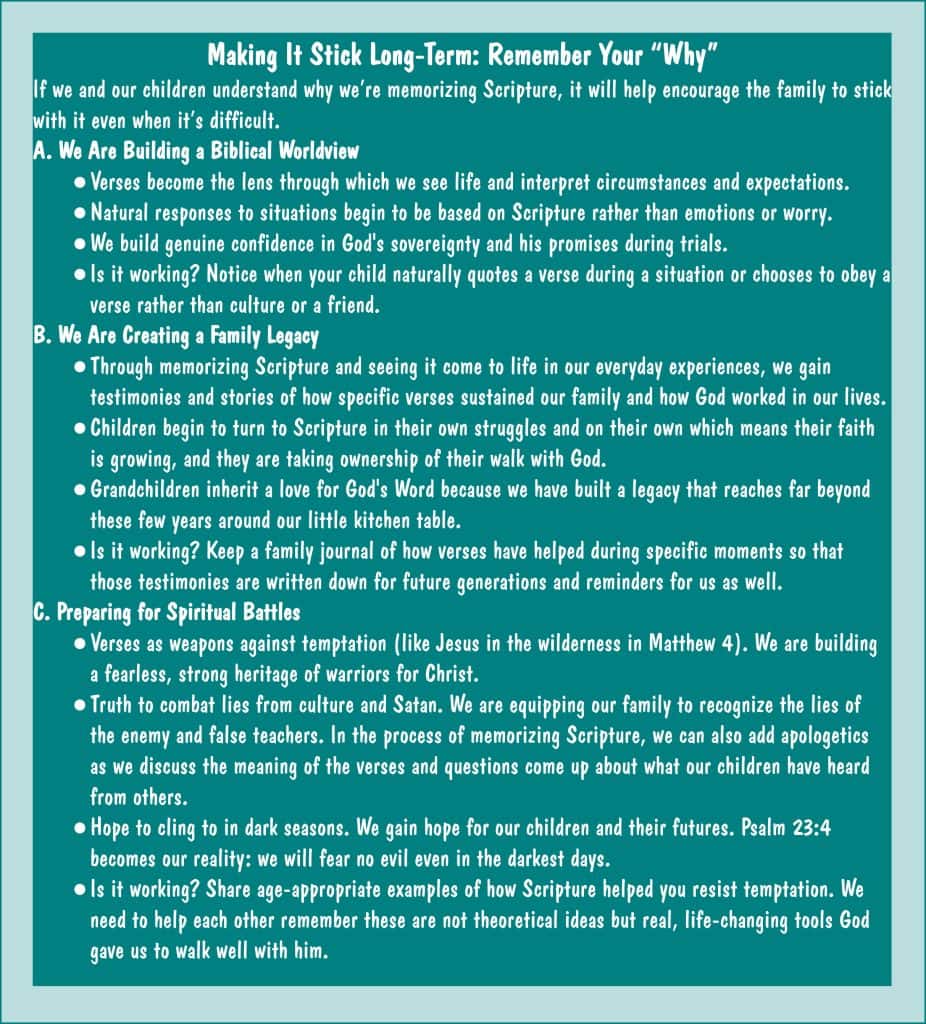
But before we get there, let’s set you up for success right now. Below you’ll find two game-changing resources: a step-by-step guide to launch your first week (because sometimes the hardest part is just starting), and the long-term vision that will keep you going when motivation wanes. Because here’s the honest truth – some days YOU won’t feel like doing Scripture memory either. We’ve all been there! The good news? God can use even our imperfect, inconsistent efforts to plant His Word deep in our families’ hearts.
Drop a comment and share your own Scripture memory wins or challenges – we’re all learning together! And if you’re ready to jump in with both feet, check out our Summer Bible Memory Challenge with free downloads designed to make this journey easier and more fun for your whole family.