Books & Resources
Scripture Memory That Sticks: Making God’s Word Come Alive in Daily Life, Part 1
July 25, 2025

As a mom and teacher, I am always amazed at how easily children can memorize anything. In the Chinese school system where I taught for several years, students are masters at memorization. However, one of the things I notice with all this amazing memory is that sometimes it doesn’t become deeper than simple memory. Students don’t own what they have memorized. They only remember material long enough to satisfy a test. I would have students who could ace a test but could not answer the simplest question about the material after the test. Eventually, I was very excited to teach at a school that taught mastery of the material. To truly teach students, we sought to require and inspire students to own the material we were teaching them.
As parents who want our children to grasp God’s word, we need to have the same plan to teach mastery. It isn’t enough to just memorize Scripture, although even then the Holy Spirit can use those words in our hearts and lives. But we want our children to grow in knowledge and understanding of God’s Word, and we want to see them grasp who God is and what his plan is for their lives by knowing his Word.
I have friends who have memorized huge sections of the Bible, and I always wish I could do that well. So far, I’ve struggled. Still, even failed attempts have helped me grow as a believer because I’ve dug into the Word more deeply and hidden more of it in my heart and mind. No effort in Scripture memory is lost. It’s all good unless we’re perfectionistic and legalistic about it all. Instead, if we can delight in and love God’s Word, memorization becomes exciting and filled with life. With the right plan and attitude, Scripture memory can become a living, breathing part of family life.
Why Most Scripture Memory Programs Fail
Why does Scripture memory fail or become drudgery? Attitude and purpose are the biggest culprits. For instance, when memorization:
- Is disconnected from real life – verses are learned in isolation
- Is performance-based – focused on perfection rather than heart transformation
- Is the end goal – putting gold stars on a chart is the focus and end goal
- Uses a one-size-fits-all approach – ignoring different learning styles and ages
- Has a lack of context – missing the story and meaning behind the words
Biblical Foundation for Memorizing Scripture
Why do we even want to memorize Scripture? Isn’t reading God’s Word enough? The Bible tells us:
- Psalm 119:11 – “I have hidden your word in my heart that I might not sin against you”
- Deuteronomy 6:6-9 – God’s Word should be woven into daily activities and routines
- Colossians 3:16 – “Let the word of Christ dwell in you richly…”
- Psalm 1:2 – “…His delight is in the law of the Lord, and on his law he meditates day and night.”
The Bible seems clear in encouraging us to not only read, but know God’s word and hide it in our hearts letting it dwell in us as we delight in it. It’s like the difference between standing on the shore looking at the beauty of the ocean or maybe walking in the edge of the ocean as the waves wash over our feet, and diving into the ocean and letting the waves wash over us and carry us. We want to be washed and lavished in the Word of God, not just dip our toes in the edge of it. Our goal should be heart transformation, not simply impressive recitation.
A Few Practical Strategies That Work
Practical Purposes:
So what can we do to revitalize our Bible memory plans? How can it become full of life and meaning? First, look at the verses we choose. We can choose verses with purpose that the Holy Spirit can bring to our minds when needed. Verses can be:
- Life-situation focused: Pick verses that address current family struggles
- Character-building: Choose verses about patience, kindness, forgiveness
- Gospel-centered: Include verses that point to Jesus and the cross
- Age-appropriate length: Start small and build up, using Bible thoughts if needed for the very young.
Learning Styles:
Additionally, we can be creative in how we memorize Scripture, especially when we’re working with our children. Consider learning styles. As a teacher, I often planned lessons and activities that appealed to different learning styles. With our children we can see when they really enjoy an activity because it resonates with their preferred learning style. For instance,
- For Visual learners: Create hand motions, picture cards, or puzzles, pictures, and written displays
- Auditory learners: Set verses to music, use rhythm, or record family recitations
- Kinesthetic learners: Walking while reciting, jumping to syllables, bouncing a ball while reciting the verses, or acting out verses
When we can combine learning styles, that’s even better. Not only does everyone enjoy their own learning style, but the other learning styles are strengthened. This will also spill over into their classroom work as they become more adept at using various learning styles.
Learning Style Combination Activities:
- Create a chart with hand motions, act them out as everyone recited the verses together
- Write a song for the verses, write the song on a colorful chart, and make up hand motions to use as you sing it.
- Use a white board to write out the verses and use the “erase-a-word” game. Having it on the white board makes it more kinesthetic as writing is bigger and erasing involves bigger motions, plus the whole family can get in on the game which naturally creates a more active atmosphere while the whole family quotes the verses together and sees the verses in large letters.
Opportunities in Daily Activities:
Furthermore, we can add Scripture memory more naturally as we involve the activity in our daily routines. Deuteronomy encourages us to do this, and as parents we are commanded to bring God’s Word and ways into our daily lives. One note here: I heard a wonderful Christian teacher remind us that we are not doing ourselves or our children any favors by just reminding them “You need to share and be kind” when they are fighting over a toy. If these types of corrections have any effect, they teach behavior modification rather than heart change. When we build Scripture into our daily routine, we are looking for those teachable moments and planned teaching moments to help our children open their hearts to God’s Word and his purposes. One way to accomplish this is to include questioning and listening to our children. Let them make connections to the verses we’ve read and memorized.
For instance, at meals, make quoting a verse part of the prayer before the meal. Have one of the children choose which verse they want the family to quote and then have that child voice the mealtime prayer.
When a child makes a connection such as, for example, you feel worried about something, and your child reminds you, “Mom, remember what 1 Peter 5:7 says, ‘Give all your worries to him, because he cares for you,’ stop and acknowledge this encouragement from your child and quote the Scripture together and pray about what’s concerning you. Can you see how powerful this would be in your child’s life?
Another idea is at bedtime, let one child choose the bedtime story and another choose the bedtime Scripture.
One of my favorite ways to involve Scripture in your daily life is to put verses around the house. We like to use sticky notes, but children could create colorful drawings with a verse on the page and hang them in surprising places. It can become a fun game as different family members find places to put verses, and at dinner everyone can share where they saw verses that day and which verses they reviewed as a result.
A variation of this idea is to hide words from the week’s verses around the house for children to find. At dinner or before bedtime, everyone brings the words they found together, and the family puts the words in order and reviews the verse before bedtime. We always loved treasure hunts.
In other words, be creative and have fun. Bible memory will happen naturally when it is part of your daily family routine and is enjoyed by the whole family.
Context and Connection:
Finally, give the verses context so that they have the life they are meant to have. These are not proverbs pulled from random thoughts of men. These are the words of God and the stories of faith in our Bible. Connect the verses to the context and the stories and the people of the Bible. Then, also connect it to the bigger story of God’s redemptive plan. We find we’re creating little Bible scholars who love God’s Word the more we do these things, and we’ll learn a lot more of God’s Word too.
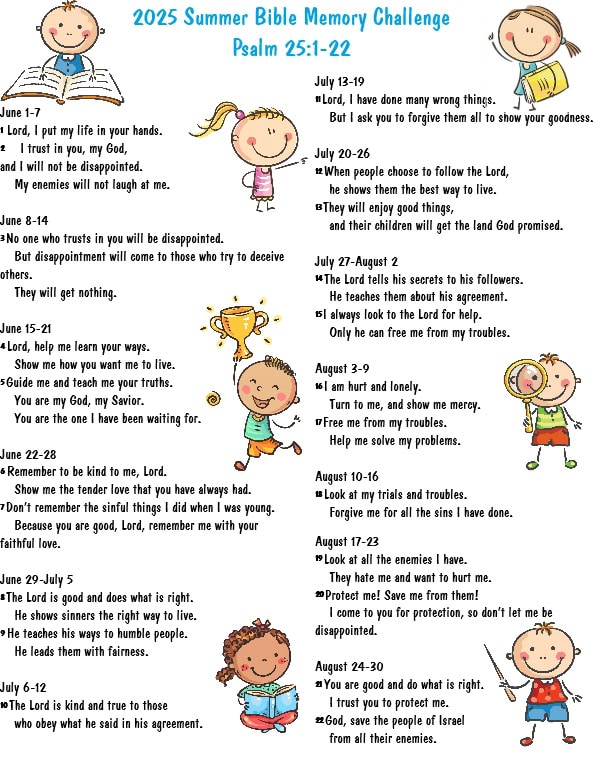
Next week we’ll continue this journey into Scripture memory ideas and plans. In the meantime, remember we have a summer Bible memory program. We’re memorizing Psalm 25. It’s not too late for you to jump in and memorize this great Psalm or at least a good section of it. It is very encouraging, and I know your family will be blessed to have these verses in their hearts. We have completion certificates, stickers, worksheets, and coloring pages to go with it. You can find them here on my website.
These foundational strategies will transform how your family approaches God’s Word, but what about when challenges arise? Next week, we’ll tackle the common obstacles that derail Scripture memory and share creative methods that make verses stick for different ages.