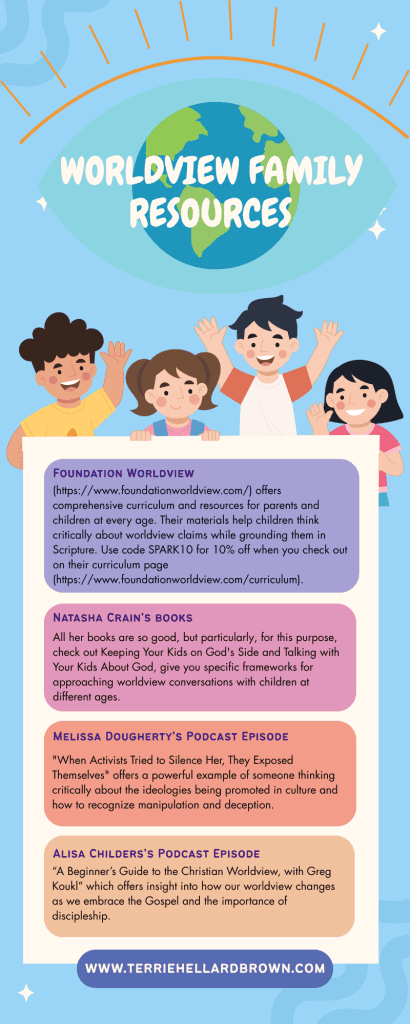
Discipling Our Younger Children to Seek Truth in a World Full of Rhetoric
When we were in Venezuela in 2006, the TV had channels of just the leader speaking; whenever the station was on, It was just him speaking and teaching his Socialist philosophies. In Taiwan, we had the Buddhist stations that did the same thing. All day, every day, they taught their beliefs. In our culture, in the USA, we’ve seen the Christian stations that do the same teaching beliefs 24/7. However, we have a similar system more than we may realize, even when we ignore the news channels. They’re called sitcoms and cartoons. Every program we watch teaches us worldview, culture, and ideologies. Even the channels that we think will promote and support a Christian worldview often slip in non-Christian ideals.
The noise is constant. Between social media, television, school, peers, and the broader culture, our children are being bombarded with ideas—some true, some false, many subtly mixing truth with lies in ways that are hard to detect. As a parent, we can’t shield them from all of it. But we can raise them to think critically about all of it.
The goal isn’t to raise children who simply believe what we believe. The goal is to raise children who can recognize truth, who think carefully about claims being made to them, who ask good questions, and who—most importantly—are rooted in Scripture and gospel identity deeply enough that their identities are firmly built on the foundation of Truth that isn’t shaken by other ideologies and a need to feel like they belong.
This is discipleship. And it starts earlier than we might think. Here are some ideas of what we can do:
Build a Family Culture of Critical Thinking
Critical thinking doesn’t mean having an argumentative or cynical attitude. Critical thinkers ask good questions and think carefully about answers, noticing faulty logic. They recognize patterns. True critical thinkers possess intellectual humility and are teachable—being willing to say “I don’t know” or “I was wrong about that.”
In our homes, it might look like this:
Questions over answers. A child comes home with an idea they heard at school or from a friend that is contrary to a Christian worldview. Our instinct might be to immediately correct the child. Instead, we should pause. We can ask questions like: “That’s interesting. Why do you think that’s true? What evidence have you seen for that? How does that fit with what we know about God?” Questions invite thinking, helping our child discover the truth and begin to recognize the lies. Correction may be accepted by the child, but it hasn’t taught her to think through the ideas being thrown at her daily. In addition, a child who grows up in a home where questions are genuinely welcomed isn’t afraid to investigate ideas and knows she won’t be shut down if she asks her parents questions. She also most likely will become a young adult who can ask herself hard questions too. The fear of rejection if asking a question is gone. The fear of investigating truth is gone. We are giving our children freedom to think, analyze, and question with a proper attitude—curiosity rather than rebellion, seeking truth instead of resentful conformity—and to be teachable.
Listening before lecturing. When our children say something we disagree with our first move should be to understand why they believe it. What are they responding to? What concern does this idea seem to address? Often, young people embrace ideologies because those ideologies are answering real questions—about justice, about belonging, about meaning. If we can find the legitimate concern underneath the problematic idea, we can have a real conversation. We might say: “I see why that appeals to you. I care about justice too. Here’s where I think this idea goes wrong…” When we’ve created a culture of critical thinking, conversations are a natural part of family life. We can talk about anything with our children, and we should. We need to be the first ones to approach any subject without hesitation, but with prayer and wisdom. Be brave. Be wise. Be willing to discuss.
Modeling intellectual humility. We can let our children see us change our minds. It’s a good thing to let them hear us say, “I was wrong about that.” We want them to observe us listening respectfully to someone who disagrees with us. And it is okay to let them see us admit when we don’t know something. Children whose parents are defensive or who won’t engage with legitimate questions often swing hard in the opposite direction. But children whose parents model genuine humility learn to hold convictions without requiring everyone else to agree. We are teaching them what humility and meekness look like. They are learning not to be threatened by someone else’s ideas. Their beliefs are not threatened by someone disagreeing with them. They also can grow in confidence to be able to defend their beliefs without needing to convince the other person to agree with them.
I’m spending a little more time on this point because I think it is an essential one that we all struggle with. For instance, when we share the Gospel with someone, we desperately want them to know Jesus. We can be so zealous, we push too hard. We get too intense. When we are confident in our faith, but we are still humble and loving, we can back off. We know that Jesus is the only one who can change hearts anyway. Our job is just to share, discuss, and pray. When someone is not open, we should be able to end the conversation with an open invitation to come talk to us any time they have a question and then walk away praying for God to continue the work he has begun in that person’s life. (This is why I love the 3 Circles example of sharing the Gospel. Check it out here: Pay special attention to the red light, yellow light, and green light discussion.)
We need to learn this same attitude and action when discussing anything with those who disagree with us—even politics or our favorite theological point. We may find it difficult to end a conversation on a calm note and walk away, but that should be our goal. When emotions are coming into the conversation, we need to find a way to regulate our own feelings and de-escalate the situation. We want to leave an open door for further discussion in the future, not prove our point and win the argument. We need to check our hearts and understand our motivation in the conversation. (Here is a short video with three great points in de-escalation: https://youtu.be/4qsfBCatgX8?si=7zVwa5L-WPzjjcAi)
Build the Foundation on Scripture and Gospel Identity
Before our children encounter competing worldviews, they need to know Scripture for themselves. They need more than Christian platitudes and sayings taken from songs, but they need actual Bible. And they need to know why it matters.
Read Scripture together. Family Bible reading doesn’t have to be long or boring. It can be messy and questioning and real, which is really awesome! That means they see the importance and are taking the time to think about what we’ve read. We want them to go beyond “Sunday School answers.” When we hit a hard passage, we must resist the temptation to just explain it away. It’s a good thing to let our kids wrestle with it. Sometimes we need to wrestle with it too. I often tell my children or students that I come away from some passages with more questions than answers, and that’s okay. That doesn’t change who God is and what I know to be true, and God is not afraid of our questions. We can respond to our children with, “That’s a tough one, isn’t it? What do you think about that?” Children who have actually read the Bible and thought about it are far less likely to be confused when someone misquotes it or twists it to support an ideology. When we show them that we sometimes struggle to understand or question something we’ve read while still knowing and believing it is God’s word, we help them to also be wary of spiritual abuse. We aren’t just protecting our children from opposing worldviews but from abusing the Christian worldview.
Help them see their identity in Christ. If a child’s sense of worth and belonging is rooted in Christ—in the fact that they are loved, that they have purpose, that they matter—they won’t need an ideology to feel like they belong or to be a hero in a narrative. But if they’re searching for identity and meaning and community, they’re vulnerable to any ideology that promises to give them those things. We can constantly remind our children: “You are loved. You matter. You have purpose because of who Christ says you are, not because of what you achieve or what group you belong to.” We reiterated this often as well as telling them we would love them no matter what. True love is not based on performance or behavior modification and fitting into an ideal in outward appearance. True love is based on my commitment to love and accept you as a person regardless of your actions. That is the kind of love God gives us. It never condones sin, but it does love us in spite of our sin and our sinful attitudes. That kind of love helps a child know they belong and are part of something bigger than themselves when they embrace and accept that love.
Build Understanding and Armor Against Rhetorical Manipulation
All ideologies—progressive, conservative, religious, secular—use similar patterns to gain loyalty. Teaching our children to recognize these patterns makes them resistant to all ideological manipulations, not just one.
The in-group/out-group dynamic. Every ideology creates an us-versus-them narrative. “We are the ones who care about justice/truth/freedom, and they are the ones who don’t.” We can ask our kids: “Does this idea make you feel like you’re better than people who disagree? Does it make people who think differently seem bad or stupid? That’s often a sign that something isn’t quite right.”
Moral superiority. Ideologies can make us feel like joining them makes us morally superior. “If you believe this, you’re a good person. If you don’t, you’re bad.” We can question this with our kids: “Does believing this make someone a better person? Can good people disagree about this? What if someone has different reasons for believing differently?”
Discouraging questions. Healthy ideas welcome questions. Ideologies often discourage them. “Don’t ask that—it shows you don’t have enough faith/aren’t committed enough/are being influenced by the enemy.” We must teach our children: “If an idea can’t handle questions, that’s a red flag. Truth is strong enough to be questioned.”
Emotional manipulation. Ideologies can make us feel things intensely—righteous anger, fear, urgency. This isn’t inherently wrong, but it’s worth examining. We can help our kids ask: “Am I believing this because I’ve thought it through carefully, or because I’m caught up in how it makes me feel? What would I think about this if I weren’t emotionally activated?”
Us-versus-evil framing. “We’re fighting against evil, and if you’re not with us, you’re against us.” This is powerful and motivating, but it’s also how people justify treating others badly. We can ask our kids: “Can people who disagree with us still be good people? Can we fight for what we believe in without demonizing people who think differently?”
Note: People are all “good people” in the sense that they have inherent value and are created in the image of God. They are not worthless or worthy of being discounted as too stupid, wrong, or evil for love. That is a tough idea, but it is true. We can help our children think about the most evil person they can think of. I often think of world leaders who are persecuting their own people. Are they acting evil? Yes. Should they be punished and stopped? Yes. But does God still love them? Yes. Should we pray for them? Yes. When we can help our children understand this, we can help them reject the rhetoric that often leads to these abuses.
What We’re Actually Building
When we do this work, we’re not raising children who will agree with us on everything. We’re raising children who will think.
You’re raising children who will be able to recognize the problems in progressive ideology and Christian nationalism and consumerism and any other system that promises belonging or meaning or identity outside of Christ.
You’re raising children who can hold strong convictions without requiring everyone else to agree with them.
You’re raising children who can engage respectfully with people who believe differently, because they’re not threatened by different ideas—they’re confident enough to examine them.
And most importantly, you’re raising children who are rooted deeply enough in Scripture and gospel identity that when the world throws ideologies at them, they have something solid to stand on.
This is the best defense against ideological capture. And it’s also the best preparation for living faithfully as a Christian in a pluralistic, post-Christian world.
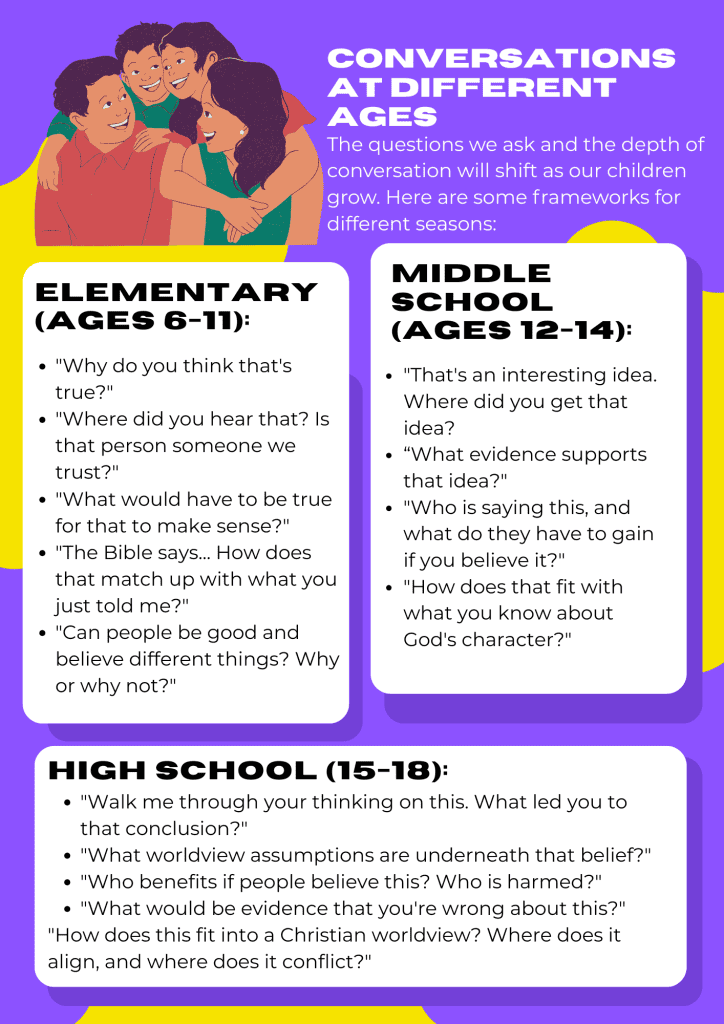
Free Download: PDF of Worldview Conversations